From Pollica, a laboratory that turns the future into a practice of relationships
There is a precise moment when you realise that something has stopped being an idea and has started becoming real. For me, that moment repeats itself every time I arrive in Pollica.
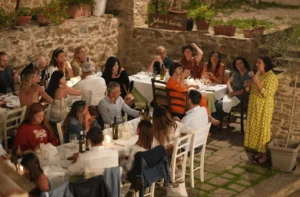
When I see young researchers spreading out among vegetable gardens and olive groves. When I find students sitting at Jerry’s playing cards with the grandfathers and grandmothers of the community, and realise that the research has already begun. When I see scientists building alliances with the community before even starting an experiment. When artists transform a medieval castle into an open laboratory without asking themselves whether it is the right place, because they already know that it is.
It is not a project. It is a living organism.
We need to be honest about where we are. We are not going through a phase of transition. We are entering an era of systemic disruption. And before you think it: this is not catastrophism. It is simply that looking at the data without filters requires a certain amount of courage.
Climate instability. Geopolitical fragmentation. Unprecedented technological acceleration. Growing social and mental fragility.
Our systems are not simply under pressure: they are beginning to give way. What we are witnessing is not a temporary crisis. It is a structural shift in the human condition.
In this scenario, a safeguarding plan is not enough. We need something more ambitious and more courageous: a reconstruction plan.
Safeguarding is defensive; it preserves what remains. Rebuilding is intentional: it regenerates.
And regeneration, of ecosystems, communities, food systems, trust and meaning, does not happen from the top down. It emerges place by place, community by community.
This is the premise from which everything begins. And Pollica, with its history, its stubborn beauty and its vocation to serve as a laboratory, is one of the most concrete answers I know.
Where all this comes from
In September 2020, in the midst of the pandemic, Pollica hosted the Climate Shapers Boot Camp organised with FAO.
We had just emerged from months of forced lockdown, and in that village in Cilento, a UNESCO Emblematic Community of the Mediterranean Diet, something broke open, in the best possible sense.
The truth was there, uncomfortable and luminous: the world did not need to start again as before. It needed people willing to live together differently. It needed real prototypes, places capable of imagining and practising a different way of being together.
This is how the Paideia Campus was born: not an academic campus in the traditional sense, but an international experimental hub where people can learn a new form of sociality and fully experience the concept of integral ecology.
The name itself comes from Ancient Greece, paideia meaning the process of integral education of the human being in relation to their environment. A semantic legacy that takes concrete form in Pollica, among olive groves, coastal landscapes and centuries-old knowledge.
Its home is the Castello dei Principi Capano. A medieval castle, yes. But above all, the place that Angelo Vassallo, mayor, fisherman and visionary murdered by organised crime in 2010, had restored for his people. Not for tourists. For the community.
The project was born from there: from the Municipality of Pollica, from the Study Centre that bears his name, and from the Future Food Institute.
It comes from the same conviction that inspired Angelo: that a place can choose who it wants to be. That beauty and justice are not in conflict. That regenerating a territory means first and foremost regenerating the relationships between the people who inhabit it.
What it means to experiment in a place
I recently wrote that the future belongs to places that choose “who” they want to be.
Pollica is one of those places.
Through political vision — that of Mayor Stefano Pisani — pragmatism and experimentation, there are people who have not simply welcomed change: they design it, have made it liveable and are transforming it into everyday practice.
Over the past six years, the Paideia Campus has played its part by welcoming researchers, students, scientists, entrepreneurs and policymakers from around the world.
It has activated innovation projects in agriculture, food, the environment and sustainable tourism.
It has demonstrated that a small village in Southern Italy can become more than a cultural attraction: a bioregional hub of resistance and quiet revolution.
Because what was born in Pollica did not remain in Pollica.
The model is now part of the European network of Bioregional Weaving Labs. It has inspired the Living Labs of Tokyo and Montepaldi-San Casciano, in the heart of Tuscany.
It is being replicated through a seed network across the wider Mediterranean, including Egypt, Morocco, Tunisia and Jordan, where very different territories recognise the same need: to build the future starting from what they have, not from what they lack.
It is not a model to export. It is a mindset to learn. It is a language to share.
The model is not about enhancing the past. It is about regeneration as a practice for the future: starting from what a territory already safeguards, the Mediterranean Diet, Cilento’s biodiversity, the living memory of communities, to build new, scalable and transferable solutions.
The paradigm shift this requires is precise: moving from extraction to regeneration, from efficiency to resilience, from scale to intelligence rooted in places, from control to care.
This is not a technical challenge. It is a civilisational challenge.
The “A World Is Possible” Residency: Art, Science and Community
April 2026.
Seventy students, researchers and PhD candidates from the New Technologies of Art programme at the Academy of Fine Arts of Naples and the University of Naples Federico II, guided by Professors Franz Iandolo, Veronica Nasti, Alfredo Capuano and Marco Salvemini, arrived at the Castello dei Principi Capano.
Not as tourists, not as visitors: as artists, researchers and temporary inhabitants of a community that learns by doing.
The “A World Is Possible” residency, first launched in October 2024 within the PNRR P+ARTS programme, Partnership for Artistic Research in Technology and Sustainability, is much more than a public art project.
It is an experiment in citizen science and citizen art: the local community is not a spectator, but an active protagonist in the production of knowledge.
Even before formal research begins, relationships are built, trust is generated and participation is activated. It is a paradigm that overturns the traditional separation between those who study and those who are studied.
Read the full article.