How can we activate entrepreneurship within a context where school dropout and unemployment rates are among the highest in our country?
This was the challenge at the heart of “Agri-Culture – Youth Welfare,” a project launched in June 2021, working side by side with young people from Pollica, in the heart of the Mediterranean Basin.
It is well known that Italy can do better when it comes to education. Our country ranks third in the EU for school dropout rates, with data showing that in 2020, 543,000 young people between the ages of 18 and 24 left school after completing middle school.
Yet it is in Southern Italy that we find the highest rates of Early Leavers from Education and Training: 17.3% in Campania, alongside Sicily at 19.4% and Calabria at 16.6%.
The main causes are cultural and social factors, family educational background and economic motivations, but also dissatisfaction with the educational opportunities available and the attractiveness of the labour market.
A School of Entrepreneurship
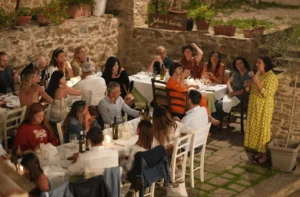
It is precisely to address these gaps that the “Agri-Culture Youth Welfare” project was created: a 10-day course held at the Castle of the Princes Capano, starting from the dreams and frustrations of Pollica’s young people, the challenges characterising the territory, but also the potential that the local context can offer.
By applying innovative coaching methodologies and Design Thinking, the project aims to discover and enhance hidden values, create new opportunities and redistribute beauty for collective wellbeing.
To achieve this goal, the first phase of the project is focused on knowledge: understanding the target group, defining final goals, and mapping local stakeholders in order to increase young people’s awareness of the surrounding territory, its potential and its main challenges.
Working with young people rather than for them was the project’s added value: increasing real-life connections, encouraging peer-to-peer interaction and reactivating the sense of unity that still characterises places so rich in culture and history.
And we started precisely from these challenges.
Within just a few days, the young participants began defining the details of their entrepreneurial projects, outlining the benefits their ideas could bring both to the territory and to the local population.
This was achieved by helping them rediscover their land through different eyes, accompanying them on visits to local farmers and producers to learn about their methods and activities, and encouraging them to interview their target audiences, from children to adults.
The beauty of hearing amazed local residents say, “I didn’t know this producer existed, it was very interesting to rediscover Pollica,” was the real magic of this training experience.
Returning to Values
The success of this project was possible because values were placed at its core.
Values that inspired the young people of Pollica to pursue their dreams, values they can return to at every stage in order to assess their progress, and values that can be shared to involve new stakeholders in the project.
Values that include both people and the territory, and that must be returned to the land.
The most important outcome of this project was seeing the seeds of change emerge among the young participants.
The young people became increasingly engaged in the project and more confident with each passing day.
They began their journey toward a new way of approaching everyday life, moving away from a problem-based mindset and starting to embrace a new perspective: opportunity-based thinking through which they could evaluate their routines and their territory.
Local challenges awakened an active interest and a sense of pride, encouraging young people to begin talking about their entrepreneurial ideas even outside of “class hours.”
Their communication skills also improved, making them more effective in public speaking and more engaging during the idea-sharing phase.
This self-awareness marks the beginning of a long journey of knowledge, perfectly intertwined with a sense of community and the distinctive characteristics of the local territory.
This is the agri-cultural revolution we are envisioning.
These are pivotal aspects that can benefit Pollica.