The Mediterranean Sea has uniquely shaped historical connections and cultural influences since ancient times. This melting pot of diversity made the Mediterranean an important hub for the exchange of products, culinary knowledge and cultural influences which, once brought together and enriched by one another, formed this unique cultural heritage.
Even today, the importance of the area remains vibrant and alive. Situated between the Greek colonies of Magna Graecia, Arab influences, and the indigenous Etruscan and Lucanian peoples, the Mediterranean has been marked by a continuous succession of events, traditions and innovations that together make up the history of the Mediterranean Lifestyle.
One of the most important is the “invention” of the definition Mediterranean Diet, whose etymology comes from the Latin word invenire, meaning “to discover” or “to recognize.”
It is the result of a foreign gaze, that of the two American scientists Ancel and Margaret Keys, who identified a healthy and resilient system of life and nutrition, capable of crossing historical eras and cultural intersections to survive up to the present day.
Common Values Beyond Geographical Borders
Since 2010, the entire world has celebrated the Mediterranean Diet as an intangible cultural heritage of humankind.
Seven are the emblematic communities of the Mediterranean Diet: Agros (Cyprus), Brač and Hvar (Croatia), Soria (Spain), Koroni (Greece), Pollica (Italy), Chefchaouen (Morocco), Tavira (Portugal).
“The Mediterranean Diet is much more than just a list of foods. It promotes social interaction, as communal eating is the basis of the social customs and holidays shared by a given community, and has resulted in a remarkable body of knowledge, songs, maxims, tales, and legends.”
UNESCO
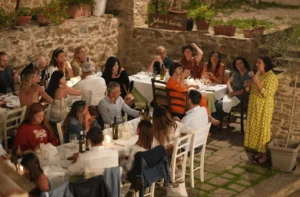
Among the emblematic communities, identity is shaped by common values such as sharing, conviviality, openness, togetherness and hospitality, but also by simple and powerful actions: strong respect for natural cycles, deep social bonds, and attention to personal, community and natural wellbeing.
Despite these similarities, it is important to understand that cultures, approaches to life and eating habits are instead the outcomes of diversity.
Each emblematic community is uniquely different from the others in terms of landscape, climate, history, biodiversity, rituals, traditions and mastery: they all preserve their local characteristics, such as local varieties and recipes.
Diversity is a key approach to resilience and sustainability.
It is the magic recipe at the heart of the Mediterranean Diet, where each of the seven emblematic communities composes a precious, albeit different, piece of the Mediterranean mosaic.
It is therefore worth listening to the stories that the Mediterranean can offer.
These are stories of resilience and good living, stories of wise management of natural resources, stories of ancient or forgotten skills and techniques.
Traditional sustainable fishing techniques are a clear example of this, such as Menaica fishing, which shows that it is possible to fish while respecting the sea and promoting collective regeneration.
The humble approach to beekeeping is also deeply rooted in history, as humans in the Mediterranean region have been interacting with bees for 8,000 years, as documented by rock paintings in Spain.
Even starting a conversation with local grandmothers, custodians of Mediterranean wisdom, can lead to the discovery of particular recipes and reveal hidden secrets.
All this can happen when one is willing to listen and open to sharing.
The Mediterranean, and the emblematic communities of the Mediterranean Diet, show that it is possible to achieve a sustainable way of living when unity and cooperation are present.
The Croatian Emblematic Community
As part of the celebration of the International Week of Italian Cuisine in the World, Zagreb, Croatia hosted a week-long photographic exhibition to honour the tradition, legacy and contemporary identity of Italian cuisine.
The location is particularly significant for Italy, since Croatia and Italy are closely connected through their shared cultural heritage linked to the Mediterranean Diet.
Similar to the Italian community of Pollica in Cilento, the two Croatian islands of Brač and Hvar are among the seven emblematic communities of the Mediterranean Diet.
Since 2013, they have represented the Mediterranean lifestyle in the northernmost geographical area of the network, in the heart of the Adriatic Sea.
With an average population of 12,000–13,000 inhabitants, these two Dalmatian islands confirm that the Mediterranean way of life is still alive, transmitted, protected and celebrated.
Although over time the availability and frequency of certain foods have changed and adapted to different lifestyles, the basic ingredients of fishermen’s and farmers’ cuisine have remained unchanged over the last 70 years.
Even today, the diets of the inhabitants of Brač and Hvar include vines, olives, goat products, sardines, vegetables, legumes and cereals.
Many indigenous varieties in the Mediterranean area are in fact recognised for their resistance to environmental stress factors typical of both the past and present of the geographical area.
A representative example is offered by some ancient grape varieties typical of the Croatian islands, perfectly adapted to the region’s microclimate.
The use of wild plants is also widespread in food preparation.
Varenik, a specific condiment made from wine must (mošt), is one of the foods that bears witness to the long-standing food practices of the Mediterranean and Adriatic regions.
Celebrating Italian Cuisine around the world also means celebrating the common values that form the foundation of all the emblematic communities of the Mediterranean Diet, crossing Italy’s geographical borders and reaching other Mediterranean communities such as Croatia.
This can be achieved through sharing recipes, conviviality, stories, knowledge and photographs, as happened during the week in Zagreb.
“Photography is an austere and blazing poetry of the real.”
Ansel Adams