With “Trame Mediterranee”, TRED comes to Pollica.
Since 1999, every year on August 12, the International Youth Day has been celebrated. Established by the United Nations General Assembly, the Day calls on the entire world to implement policies that help young people overcome increasingly complex challenges, support them throughout this process, and above all remind everyone of their fundamental role as agents of change.
Today, we celebrate this Day, which is particularly meaningful to us, by telling you about our “future factory”: the Paideia Campus. For the past four years, it has been growing in the heart of the Lands of the Mediterranean Diet, a unique place in the world, an educating territory where an ecological awareness rooted in thousands of years of history has become the natural incubator of what we like to call the “longevity algorithm”.
The Campus experiments with innovative educational models for integral human development, starting from consciousness — awareness — and “Prosperity Thinking”. These are evolutionary and transformative experiences built around encounters with visionary figures — public administrators, guardian farmers and fishermen, entrepreneurs, creatives, scientists, artists and designers — as well as immersive activities that allow participants to experience good practices firsthand and engage with real-world challenges. The aim is to develop the mindsets and skills required for genuine integral ecological development, reconnecting body, mind and soul with what is essential and with the land.
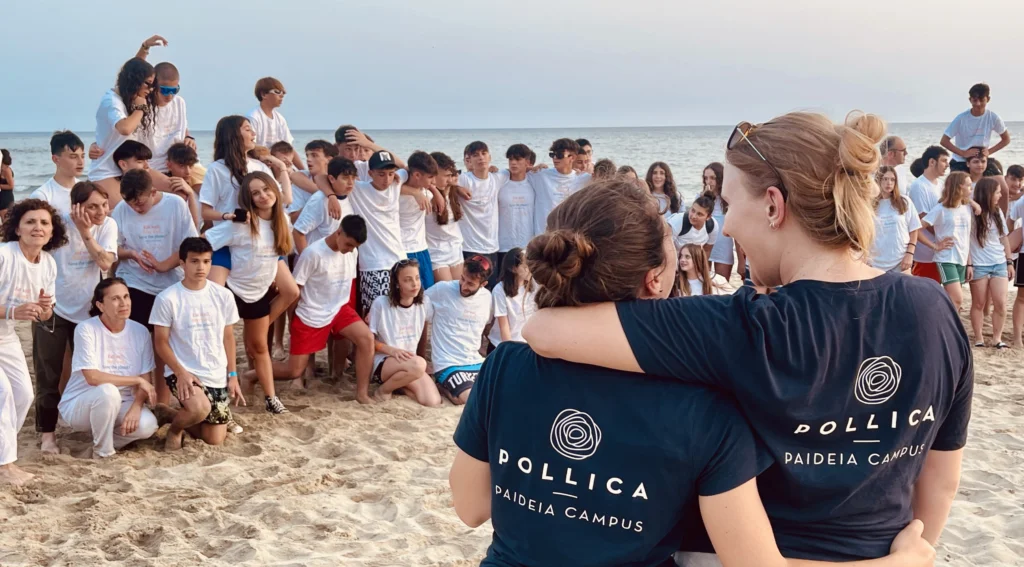
Under the direction of the Future Food Institute, Paideia Campus welcomes more than 2,000 young people every year to Pollica through bootcamps, summer schools, educational trips, training courses for teachers and school leaders, executive programs, master’s programs and international initiatives.
In 2023, it also launched an immersive program dedicated to students from the Applied Sciences High Schools for Ecological and Digital Transition (TRED). TRED is a four-year educational pathway that combines the humanistic and scientific tradition of the Italian high school system with the essential knowledge required to actively engage with the digital and ecological transitions.
The program focuses on developing technical and scientific skills — increasingly important for the professions of the future — while integrating them with emotional intelligence, interpersonal skills, empathy and communication. Choosing this educational pathway already demonstrates the determination of young people who want to build a future different from the one previous generations have created for them.
During May and June, TRED students from across Italy chose Pollica, Cilento and the land of Parmenides as the place to learn firsthand what it means to grow according to a model of integral ecological development. They came to see with their own eyes how the combination of science and creativity, ancient knowledge and future-oriented vision, can concretely change direction in favour of the wellbeing of our planet. They also explored how essential it is to focus on being and on our inner dimension in order to act consciously when caring for others and for the ecosystem that sustains us.
To achieve this, the Future Food Institute, thanks to its collaboration with the Municipality of Pollica and Mayor Stefano Pisani, created the Trame Mediterranee program three years ago.
Its objective is aligned with the Green Mindset initiative promoted by ELIS — Education, Work, Training and Sport — within TRED high schools: to put classroom knowledge into practice in real-world situations, encouraging future generations to develop the willingness and ability to act in global contexts.
Students from Liceo Malpighi in Bologna, Liceo A. Vallone in Galatina (LE), I.S.I.T. Bassi – P. Burgatti in Cento (FE), Liceo Battaglini in Taranto, Liceo Pascal in Pompei, I.I.S. A. Omodeo in Mortara, I.I.S. A. Volta della Val Tidone in Castel San Giovanni, I.I.S.S. Carlo Alberto Dalla Chiesa in Montefiascone, Liceo Fulcieri Paulucci di Calboli in Forlì, and I.I.S. Umberto Masotto in Noventa Vicentina chose among four different learning pathways:
Sea and Care Pathway – The Mediterraneans
Resources and Energy Pathway – The Circular Thinkers
Biodiversity and Forests Pathway – The Green Thinkers
From the Land to the Table Pathway – The Regenerators
Through these experiences, students had the valuable opportunity to engage directly with the guardians of the knowledge and creativity embedded in the Mediterranean Diet, which represents an ideal destination for both the ecological and — seeing is believing — digital transition.
Read the full article on Nova Il Sole 24 Ore.