The relationship between food, health, the environment and cultures – regeneration and sustainability: the crucial challenges of agrifood
Last month, the four-week training period of the Food Sustainability ITS Tech & Food course at the Future Food Institute came to an end.
The educational program, entitled “The relationship between food, health, the environment and cultures – regeneration and sustainability: the crucial challenges of agrifood,” began in Bologna at Scuderia Living Lab, where it ran for three weeks, and concluded with a one-week experiential program at Paideia Campus in Pollica (SA). The initiative involved 25 Food Sustainability students accompanied by one teacher.
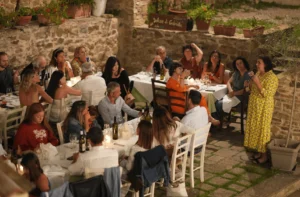
Leaving behind the environment and culture of Bologna and travelling to the heart of Cilento, the students had the opportunity not only to study the Mediterranean way of life, but also to touch, smell and taste it firsthand.
Among the main activities, the students:
- visited the Velia Archaeological Park and took part in a foraging experience, learning how to identify local plants and discover their traditional uses with local guide Fernanda Quaglia, an AIGAE guide from Cilentamente;
- participated in a Cilento olive oil tasting, exploring the benefits of olive oil and its importance within the Mediterranean Diet with Giuseppe Cilento of Cooperativa Nuovo Cilento;
- visited Tenuta Chirico, where they experienced milking and took part in a cheese-making workshop with Benedetto and Silvia Chirico;
- visited the La Petrosa agritourism farm and enjoyed a tasting lunch hosted by Edmondo and Luigia Soffritti;
- visited an earthworm farming facility with Stefano Argenziano;
- participated in a traditional homemade pasta workshop with Maria Carmela;
- visited beehives in the field and tasted honey with Pasqualino Volpe of Apicoltura Volpe.
The program therefore became a journey of rediscovery into the origins and traditions of our food culture and way of life, learning directly from the guardians of local knowledge in order to preserve and pass on the heritage of the Mediterranean Diet.
The week concluded with an hackathon, serving as the final project, centred on the concept of Integral Ecology and exploring different aspects of the agrifood system.
Through the activities described above, the students experienced the Mediterranean Diet firsthand, putting into practice the concept of “Farm to Fork”, a strategy proposed by the European Commission as part of the European Green Deal. The strategy aims to make food systems healthier and more sustainable by involving the entire food supply chain, from production to distribution.
The Food Sustainability course is built precisely on this “from producer to consumer” philosophy, using a holistic approach to foster a sustainable food culture.
Launched for the first time this year by ITS Tech & Food in Bologna, the Food Sustainability course focuses on the challenges posed by new products and changing food needs, the bioeconomy, natural resources, agriculture and the environment.
The program trains highly specialised professionals capable of making a significant contribution to the sustainable management of the food supply chain by developing specific skills to:
- understand and assess the relationship between food and human health;
- improve food safety and quality, traceability, authenticity and sustainability, protecting both citizens and sustainable production systems;
- monitor and describe productive environmental contexts, identifying approaches to enhance local territories and optimise resources;
- manage environmental certification processes throughout the supply chain;
- promote and monitor both the adoption of good practices established within agrifood measures and innovations designed to mitigate the effects of climate change;
- contribute to the management of renewable agro-energy processes;
- in line with the objectives of the European Green Deal, adopt the “Farm to Fork” principle as a key reference point for contributing to a circular economy and reducing the environmental impact of the food processing and retail sectors, with particular attention to transport, storage, packaging and food waste.