From today until October 21, the FAO Science and Innovation Forum is taking place, a forum entirely dedicated to science, technology and innovation for the transformation of agrifood systems.
Science and innovation are crucial to redesigning agrifood systems capable of promoting better production and nutrition, respecting the environment, ensuring a better life for everyone and, above all, “leaving no one behind”, as highlighted by the theme of the recent World Food Day.
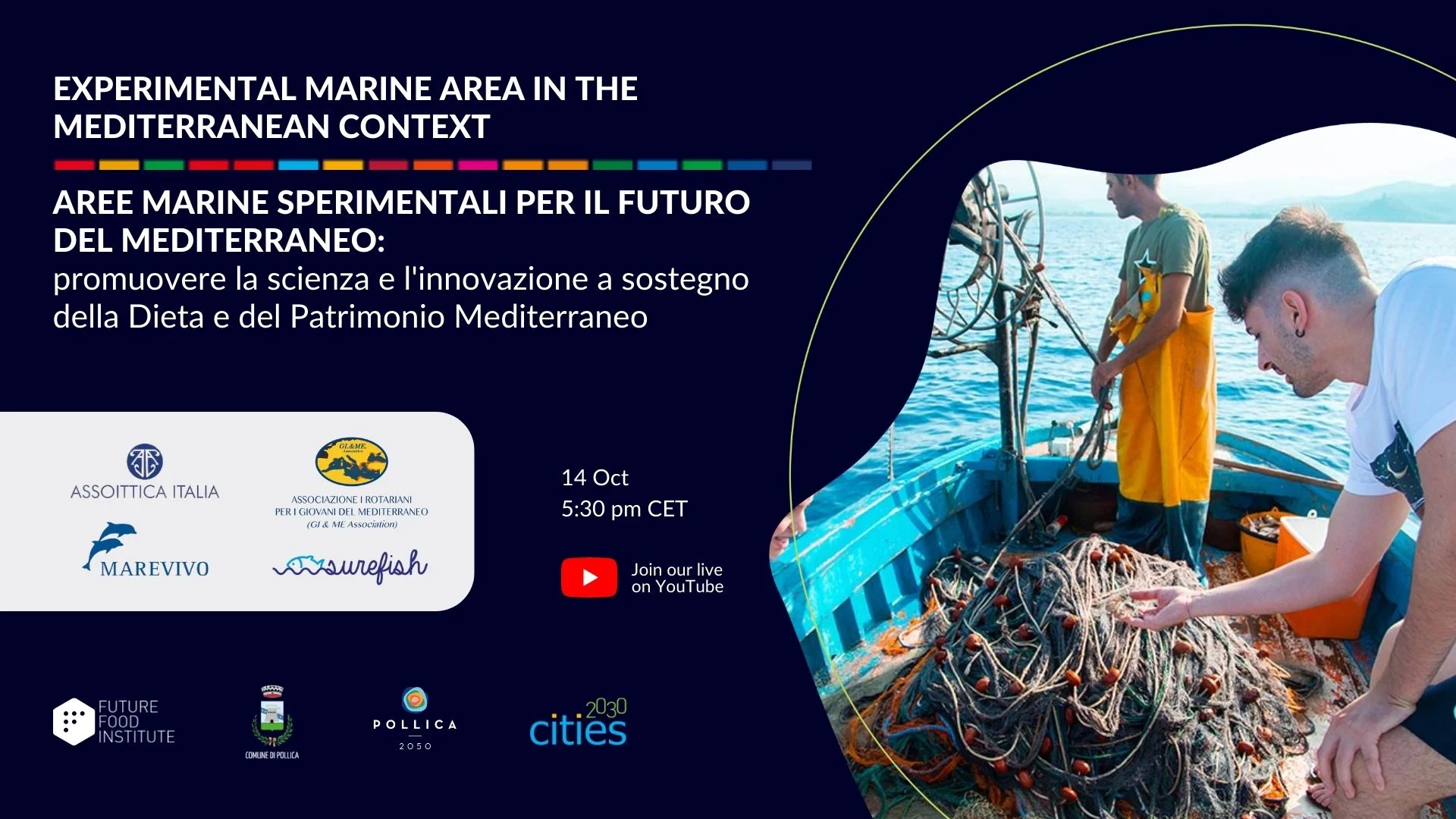
On this occasion, we are proud that our Paideia Campus in Pollica — an official partner of the European Cities 2030 network — was selected among the organizers of the FAO Forum’s side events through the virtual event “Co-Creating An Experimental Marine Area In The Mediterranean Context: Fostering Science And Innovation To Support The Mediterranean Diet And Heritage”, moderated by Domenico Letizia.
The webinar brought together a wide range of voices, all directly involved in co-creating the first Experimental Marine Area in the Mediterranean. Together, they shared some of the key ingredients needed to turn the Mare Nostrum into an inspiring and replicable model of integral ecological regeneration.
True innovation is created together
A lasting future can only be built by combining technology with culture and human know-how. This is the rationale behind the ambition to create the first Experimental Marine Area in the Mediterranean, designed to restore balance between people and the sea, fishing and the protection of marine biodiversity, extending across the Mediterranean coast from Castellabate to Sapri.
We are used to hearing about fishing bans designed to give the sea time to regenerate. But the reality is that the fishing tradition underpinning the Mediterranean Diet is made up not only of marine ecosystems, but also of fishermen: people who, long before us, had found a sustainable balance with their sea.
A perfect example is the traditional menaica anchovy fishing technique, rooted in Classical Greece, which has long demonstrated its ability to combine fishing quality, biodiversity protection and the livelihoods of fishermen.
“The Experimental Marine Area cannot be created through technology alone, but together, through the unity of the marine community and shared participation.” — recalled the Mayor of Pollica, Stefano Pisani.
This means building a community that does not see fishermen as people who simply extract resources from the sea, but as sentinels, deep experts and true guardians of the marine environment, who can also be equipped with technologies to strengthen their role and ensure their survival.
Enhancing and tracing the catch: the Surefish example
If protecting the Mediterranean also means protecting its fishermen, then the potential of technologies such as blockchain is clear, particularly in ensuring greater traceability and authenticity of seafood products.
A clear example is Surefish, a project involving 13 Mediterranean partners from Egypt, Italy, Lebanon, Spain and Tunisia, including the Slow Food Tebourba Association, Gi.&Me. Association, ENCO SRL and the University of Naples Federico II.
As Franz Martinelli, President of Gi.&Me. Association, explained, the project extends the concept of “sustainability from fisherman to consumer”, directly countering harmful practices such as illegal fishing and poaching.
As Giovanni Fiorile, PhD candidate at the University of Naples Federico II, also explained, Surefish combines traceability aimed at guaranteeing the authenticity of Mediterranean seafood products with communication campaigns designed to guide consumers toward local and sustainable seafood choices.
Educating for innovation, or innovating through education?
If there is a clear thread connecting the sea and fishing boats to consumers, it is equally clear that continuous bridges for dialogue are essential.
The knowledge and wisdom of small-scale Mediterranean fishermen are themselves a heritage that must be protected and shared. Fishermen possess rare expertise in the balance of marine ecosystems and should be recognized as genuine educators.
Bringing young people directly to the sea and creating opportunities for them to meet those who live the Mediterranean every day is part of the science, innovation and future-oriented activities promoted by the Experimental Marine Area.
This means encouraging field-based learning, but also facilitating greater exchanges of knowledge between fishermen and restaurateurs, so that seasonal products and so-called “poor fish” can be better valued through appropriate recipes and cooking techniques, while raising awareness among both local communities and visitors.
“Science, innovation and the future mean that young people need to be educated. And in this sense, education can only come from the sea.” — Sara Roversi, President of the Future Food Institute.
All of this has the potential to turn the small-scale fishing community into a true educating community.
Diversification and integration: two sides of the same coin
Only through continuous education and awareness-building within local communities can people understand the crucial role that each of us plays, through our food choices, in shaping more resilient and regenerative agrifood systems.
Giuseppe Palma, Secretary General of Assoittica Italia, made this point clearly: “Only by diversifying seafood consumption can income be distributed across all fishermen, ensuring greater environmental, business and process sustainability.”
No lasting change can occur unless the effort is integrated, holistic and participatory.
From final consumers to public policies — which now more than ever must be integrated in order to translate ecological, energy and food transitions into action — collaboration and diversification are two essential pillars.
As Rosalba Giugni, President of Marevivo Onlus, emphasized, perhaps we simply need to be “more ambitious in our perspectives and expectations” to remember how much difference we can truly make together.
The Memorandum of Understanding signed by the Municipality of Pollica, Future Food Institute, Assoittica, Marevivo and Gi.&Me. Association marked the beginning of a co-creation and co-design process that brought together 14 municipalities along the Cilento coast around a common goal: regenerating the Mediterranean Sea by starting from the role of its fishermen, a true intangible heritage for the protection of marine ecosystems and the survival of the Mediterranean way of life.
This pathway can inspire, be adapted and implemented by other municipalities and Living Labs across Europe and around the world, increasing resilience, sustainability and inclusion from the bottom up, so that more resilient, sustainable and regenerative agrifood systems can become a widespread reality.