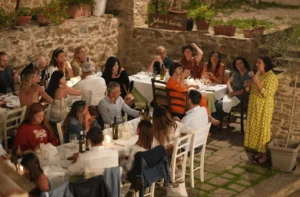
Restoring conviviality to its true value: everyday moments of individual and collective regeneration
If each of us can vote with our forks, if every individual, through daily habits and food choices, can bring us closer to development models that are not only sustainable but regenerative, then mealtimes and conviviality must return to playing a central role: everyday actions capable of reconnecting people with one another, with their land, their territory, their identity and culture, and with the care of the entire ecosystem.
Aspiring to regeneration and integrity in everyday life, also through the sharing of meals, therefore becomes essential.
The healing power of shared food
For thousands of years, conviviality has been one of the main moments associated with social life. It is no coincidence that its etymological meaning is precisely living together.
Since the earliest forms of society, sharing a meal was never merely a moment dedicated to satisfying physiological needs such as hunger. It carried deeper meanings and values: nurturing a sense of community and communion, sharing knowledge, because food is much more than energy and nourishment.
Food is family, experience, inclusion, identity.
It is no coincidence that Plutarch, the ancient Greek thinker, said that “people do not sit at the table to eat, but to eat together”, praising the culture of hospitality; Dante Alighieri wrote an entire treatise on the Convivio, a fourteen-course banquet, a true nourishment for body and spirit; Jesus Christ revealed some of his deepest teachings during banquets.
Sharing a meal also strengthens solidarity and bridges distances. In his treatise Politics, Aristotle discussed the importance of sharing meals in order to recreate within the community the same strong bonds found within the family and to reduce antagonism.
It is no coincidence that today we speak of food as a powerful form of soft power and of the table as one of the most suitable places for bringing people together, even during important agreements and negotiations.
“Give me a good cook and I will give you a good treaty”: this is how French Foreign Minister Charles Maurice de Talleyrand is said to have addressed Napoleon, well aware that the delicacies of French cuisine could prove decisive in achieving diplomatic success in the early nineteenth century.
And yet, looking at the picture of today’s society, it is easy to see how little remains of all this.
Especially because of the pandemic, opportunities for exchange and interaction have declined dramatically, while moments of conviviality have almost disappeared.
Family dinners became a metaphor for the loneliness and fragmentation that permeated our lives, as everyone was deprived of connections, generating devastating consequences for wellbeing and mental health.
It is therefore not surprising that the erosion of social cohesion and the deterioration of mental health are listed among the most worrying risks for the world over the next two years, as revealed by the Global Risk Report 2022.
Food then becomes a metaphor for gift, wealth and exchange. We nourish ourselves because we need to, and around a table we discover that we are all profoundly equal: we are on the same level, and no one can feel superior.
For this reason, conviviality is also a tool for peace and conflict resolution, and in this historical moment, marked by wars and tensions, it becomes essential for returning to our primary needs, reconnecting with other people and with the Earth, mother and giver of indispensable resources.
A Europe supporting human solidarity
The European Union has not explicitly shaped its political strategies around conviviality in the strict sense, with the exception of specific European cooperation projects, such as 4Cs – From Conflict to Conviviality through Creativity and Culture, launched to stimulate and nurture intercultural dialogue and particular opportunities for conviviality.
One recent example involved the European Union Ambassador to Morocco and young Moroccan people, who came together to reflect on the EU-Morocco partnership and joint initiatives relating to education, training, capacity building, mobility, social inclusion and support for entrepreneurship.
And yet, solidarity among Member States is one of the fundamental pillars of the founding pact of the European Union of states and communities. And conviviality is closely linked to solidarity: one is a prerequisite for the other.
Since more than 5% of the EU population consists of people born outside Europe’s political borders, it is essential to integrate these millions of people with the rest of the continent’s citizens.
For this reason, the European Union is developing a new framework that can facilitate exchange without erasing differences, highlighting the importance of reciprocal relationships.
Even the EU Green Deal only makes sense when viewed within a framework of solidarity: it is unthinkable to achieve such ambitious goals without strong cooperation among Member States, and without that same sense of belonging and community that characterizes a cohesive union, it will not be possible to reach goals that can only be achieved collectively.
Finally, solidarity formed the foundation of the European action plan for addressing the pandemic crisis and remains a key principle for confronting the wars taking place on our continent, which have affected, although not equally, all our lives.
Regenerating the world one forkful at a time
If food is, for the Future Food Institute, the key instrument and means through which we can regenerate the world in an integrated and holistic way, then the physical sharing of food — understood through its power to unite and reunite people, and reconnect people with their territory — is crucial for creating more resilient, united and aware communities.
Because it is precisely by becoming conscious of everyday gestures, such as eating together, that we can understand our impact on the world around us and on every living being that is part of it.
For this reason, conviviality and its extraordinary regenerative power — individual, social, identity-based and environmental — have been placed at the heart of many Future Food Institute activities and initiatives.
Even when the pandemic forced us to stay apart.
Through the Climate Suppers, an integral part of our digital Boot Camps, we were still able to celebrate conviviality from a distance, discussing eating habits, discovering local varieties and sharing thoughts and reflections that began with food and extended to climate change, traditions and identity.
But it is above all from our Living Lab in Pollica, at the heart of the Mediterranean and an Emblematic Community of the Mediterranean Diet, that the power of conviviality has been relaunched with exponential strength and resonance.
As UNESCO reminds us, in recognising the Mediterranean Diet as Intangible Cultural Heritage of Humanity, one of the undisputed pillars of this way of life is that it promotes “social interaction, since communal meals are the cornerstone of social customs and festive events shared by a given community, and have given rise to a considerable body of knowledge, songs, maxims, tales and legends.”
Food within the Mediterranean Diet is part of a way of life in which time is valued, as is a deep connection between natural, social and inner dimensions; food that unites and reconnects lives and people, not only with one another but also with the territory and the Earth.
This exchange does not see the Mediterranean merely as its driving force but also as its product, because what we celebrate today as the Mediterranean Diet was born from the encounters among the peoples who inhabited this area, rich in still unexplored resources, exchanges, cultural influences and connections.
Through this reconnection with our roots, we can rediscover ourselves as part of a community, rather than as small particles living isolated lives.
For this reason, every event, conference, initiative and educational pathway held in Pollica could only end with the sharing of a meal.
From our in-person Boot Camps to the celebrations of the Mediterranean Diet, from the Week of Italian Cuisine in the World to the recent European Agrifood Week.
Conviviality becomes both the protagonist and the means through which to discover the people behind food, share knowledge by bringing the field to the table, and directly experience the cultural identity of a territory.
“Trame Mediterranee – From the Land to the Banquet” was an opportunity to rediscover live conviviality and the experience of being together, starting from the ancestral source of enrichment and the common thread running through our lives: food.
At Future Food, however, conviviality is also seen and interpreted as a tool for sharing and integration, a bridge for peace between people and different worlds, a privileged channel of communication that works not through words, but through shared and collective human values.
For this reason, we promoted a fundraising initiative for Ukraine that was once again centred around the table, our point of reference, with the aim of drawing participants’ attention to the true essence of convivial gatherings: exchange and solidarity.
Future Food works with food, but food is a vehicle for relationships — with people, with nature, with ecosystems — and conviviality is the lifeblood that allows these bonds to exist.
It is the symbol and emblem of a much deeper commitment that goes far beyond simply sharing nourishment, becoming instead nourishment for the spirit and for the soul.
Because every time we gather around a table, we find ourselves honouring the past, living the present and preparing to build the future.