The challenge: embracing collective wellbeing
Regardless of what we believe in, which culture we embrace, or where in the world we live, we all share one life, and each of us is driven by common values and desires: to be happy, to be healthy, and to have access to sufficient high-quality natural resources.
And yet, never before has achieving Buen Vivir, as recognised in the constitutions of Ecuador and Bolivia, been so full of obstacles and challenges.
Pursuing collective wellbeing means, first and foremost, ensuring quality in everyday life: quality food, clean air, proper nutrition, care services, and psychological and physical health — all aspects that are reflected in animal wellbeing, environmental care and the enhancement of ecosystem services, ultimately bringing collective prosperity back to people, communities, relationships, territories and the economy. This is the true challenge of our time.
Why it matters: increasing resilience by fostering physical and mental balance
There is an enormous difference between living and surviving.
Life, understood in its true complexity, encompasses a plurality of factors and dimensions that highlight our current need to restore an ecosystemic mindset — and therefore ecosystemic solutions.
The current agrifood system is a striking example.
Self-interest, privatisation and commercialisation have arbitrarily replaced the true value of food, without taking into account everything that cannot be immediately monetised: access to land, people’s rights, gender equality, environmental regeneration, social cohesion, shared knowledge and trust.
At community level, the side effects of industrialisation have spread unhealthy generalised patterns, such as the massive consumption of ultra-processed foods, poor nutritional quality, sedentary lifestyles, monoculture and waste.
We standardise methods, but we are losing our cultural and culinary heritage. Along with it, we are losing all the richness, traditional knowledge, local crops and endemic forms of biodiversity that provide valuable ecosystem services and regulate collective wellbeing.
Despite some variations between regions, no region in the world can truly claim to promote a healthy diet, according to the Global Nutrition Report.
This comes at a cost not only to human and environmental health, but also to global economies, with the annual global financial cost increasing by US$10.8 billion in order to achieve the nutrition targets set for 2030.
This is inevitably one of the costs of conventional agriculture, which relies on massive chemical inputs and prioritises quantity over quality and profit over natural and social wellbeing.
These characteristics make it not only highly vulnerable to any external disruption — natural disturbances, energy prices, access to resources, availability of poorly paid agricultural labour — but also costly in both human and economic terms.
Antimicrobial resistance causes around 33,000 deaths every year in the EU, according to the European Commission, and costs our healthcare system €1.5 billion annually.
These are the effects triggered by a deep and gradual disconnection from natural rhythms and processes, which inevitably also undermines our current psychological and physical wellbeing.
The connection between mind and body has been theorised and recognised for a very long time: mens sana in corpore sano, said the Roman poet Juvenal in his Satires in the second century AD.
This is an awareness that we have gradually lost, or forgotten, in the pursuit of conformity with today’s performance-driven society.
We now suffer from constant frenzy, from a scarcity of time that has led us to forget the beauty of savouring the food we eat, sharing a meal with our families, preserving the quality of interpersonal relationships, and spending time outside the confined spaces of offices, homes and cities, increasingly distant from nature.
It is therefore no coincidence that the deterioration of mental health and the erosion of social cohesion are perceived as among the most worrying threats facing the world over the next two years, alongside concerns about climate change, which has now become a specific source of anxiety, especially among younger generations.
It is time to restore health to its concrete dimension: individual wellbeing, both physical and psychological; collective wellbeing; environmental wellbeing; a multidimensional understanding of health as “bio-psycho-social wellbeing”.
Restoring a healthier balance between personal and professional life is in fact one of the motivations behind the global Great Resignation, which has affected 41% of the global workforce and is inevitably bringing people back to universal human values: care, mutual listening, empathy and support.
These new priorities are capable of recreating more decentralised systems focused on improving planetary health, revitalising communities and the sense of community, paying greater attention to local economies, and placing power back into the hands of people who are more sensitive and responsive to the needs of their territories.
The ability to recover quickly from difficulties, adapt to disruption and mitigate negative effects is possible only when diversity is respected and all dimensions of life remain in balance.
The EU strategy and the need to restore a unified approach to health
Promoting genuine and collective wellbeing is unquestionably part of European strategies and policy priorities.
Since 2016, the Institute for European Environmental Policy, together with the European Commission, has explored and disseminated evidence on the positive effects of nature on people — including mental health and stress reduction — and on society, encouraging greater contact with natural environments.
According to these studies, implementing green infrastructure, in addition to considerably reducing noise and air pollution, would also foster stronger connections with nature and encourage outdoor physical activity.
Since 2017, the European Commission has adopted a new One Health Action Plan specifically addressing antimicrobial resistance (AMR), with the aim of promoting good practices in research, development and innovation to control the spread of antimicrobial resistance while jointly protecting animal and human health.
A similar commitment must also be recognised in relation to mental wellbeing.
Part of the recent EU Youth Strategy is in fact aimed at promoting multidimensional forms of wellbeing, ranging from physical activity to mental health — in workplaces and schools, including actions against depression and suicide — from care for eating disorders to the promotion of sport as a tool for teamwork, intercultural learning and responsibility.
These actions and strategies, in different ways and forms, contribute to laying the foundations for a European Health Union, in which all EU countries prepare for and respond to health crises together, medical supplies are available, accessible and innovative, and countries cooperate to improve prevention, treatment and post-disease care.
RegenerAction and the potential of the Mediterranean way of life
Individual, collective and environmental wellbeing can only be the starting point for a genuine ecological transition.
It is for this reason, and because of the urgent need to place what is essential back at the centre, that the Future Food Institute is actively working to rethink our lifestyles — even before restoring them — through holistic and integrated approaches capable of adequately considering body and mind, spirituality and nature.
This is why, right in the middle of the pandemic, Future Food decided to open a Living Lab in Pollica.
Part of the international Cittaslow movement, the “Cities of Good Living”, Pollica not only promotes the beauty of slowness — a new humanism of being and experiencing places — but is also Italy’s representative community for the Mediterranean Diet, leading this year the UNESCO network of Emblematic Communities.
The Mediterranean Model has taught us, since its ancient origins, that the only way humanity can prosper is through collective wellbeing.
Because the Mediterranean Diet teaches us precisely the idea of interconnectedness and the importance of keeping all aspects of life in balance, not only across the different dimensions of our daily lives — eating, moving, being together, and feeling healthy both physically and mentally — but also across everything around us: cultures, techniques, stories, languages, traditions, craftsmanship and knowledge.
This is the extraordinary interweaving that today we call the Mediterranean, the only true recipe for prospering together through trust, generosity, appreciation of diversity and care.
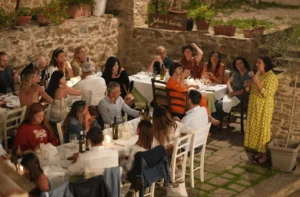
From these places of unique natural and cultural richness — from the Cilento National Park and the Archaeological Park of Velia, from marine protected areas, and from the potential of community and conviviality — students and professors, international visitors and innovators are welcomed every year to experience the quality of life that much of the rest of the world has forgotten.
Wellbeing is a fundamental element in the design of healthy, inclusive and sustainable cities, but also a new driver for promoting territories through new forms of tourism centred on biophilia and the appreciation of wild nature.
This is the Paideia Campus in Pollica: an open-air campus where people can experience nature and beauty, slowness and sharing, and regenerate themselves holistically, in body and spirit.
This is also why the Mediterranean Mind Lab in Pollica, developed by Strobilo in collaboration with the Future Food Institute, was created: as a research initiative aimed at studying our relationship with nature through neuroscience, starting from the monitoring of environmental and human health.
The ambition is to create a genuine algorithm for longevity and human wellbeing, which requires us to return to touching nature, approaching it, living it, smelling it, breathing it and exploring it.
Because only when something is truly experienced can it be fully understood, appreciated and loved.
It is time to reconnect with food, nature and our territories. It is time to truly feel well and to share our wellbeing with one another in order to create an increasingly broad sense of collective serenity.
It is time to restore a genuine One Health Approach.
For this reason, wellbeing will be a central theme during European Agrifood Week.
In particular, on May 26 and 27, students from Hospitality, Tourism, Sports and Agricultural Institutes will compete in a hackathon to translate the values of the Mediterranean Diet into concrete ideas and spread them among younger generations.
Follow us on Twitter!
#RegenerAction2022 #EUAgrifoodWeek2022