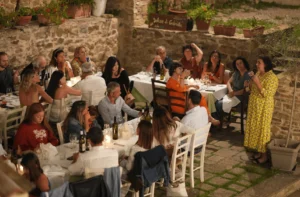
Giving voice and value to agrifood supply chains — those capable of regenerating the land and its diversity, producing healthy and nutritious food, and remaining rooted in the uniqueness and care of their territories — is one of the greatest challenges facing today’s agrifood system, which is still largely characterised by highly extractive, intensive, extensive and standardised models.
❗ We are used to thinking of food as something whose only purpose is to nourish us. Yet behind every single food product lies an entire ecosystem made of people and hard work, knowledge and traditions, local crops and endemic biodiversity — the foundations of valuable ecosystem services — as well as waiting, adaptation, risk and care; relationships rooted in the land and connected to the local territory through agrifood supply chains.
Forgetting this complexity is what is leading us to literally consume our Planet, as demonstrated by the relentless advance of Earth Overshoot Day, while “feeding” food insecurity, environmental degradation, resource extraction, climate disasters and food injustice — all factors that contribute to collective impoverishment and ultimately harm human health and survival.
This inseparable link between ecosystem health and supply chains has become even more evident through recent events: a pandemic that destabilised the entire agrifood system, the war in Ukraine that drove global commodity prices sharply upward, and the environmental and climate crisis, which is having a severe impact on the agrifood sector, especially in Italy and across the Mediterranean.
This is particularly important in our country, where the agrifood sector is a pillar of Italian GDP. Preserving local supply chains together with small and very small farms, the true driving force of the Italian economy, is therefore crucial.
They are, in fact, the undisputed protagonists in nourishing and safeguarding local ecosystems, preserving biodiversity and ancient or forgotten crops, counteracting the genetic erosion that began over the last sixty years, and ensuring greater resilience and a stronger territorial identity for the food they produce.
It is also these small local supply chains that sustain Italy’s economy of geographical indications, which holds the world record for the number of certified products with 841 PDO, PGI and TSG products — a driver that, by giving value to territories, is relaunching the national economy of quality and care abroad as well, as shown by the growth in Italian exports over the past two years despite the pandemic crisis.
Deeply understanding that working the land means having a direct relationship with life that spreads and thrives even where it remains hidden, starting from beneath the soil, carries an invaluable lesson: it helps restore the relationships between human beings that we have lost.
Agri-culture, and regenerative agriculture in particular, today represents a way to hold communities and the places they inhabit together, to cultivate the social fabric as well as the land, and to counter the risks of abandonment and depopulation, especially in small municipalities in inland and mountain areas.
These are relationships that unite communities, strengthen ties between employers and workers, but also between producers and consumers.
In light of this, it is easy to understand why the Mediterranean Diet plays such an important role in maintaining and establishing a balance that allows supply chains to survive and, even more importantly, allows the context in which they operate to remain healthy and productive.
Future Food is committed to protecting the Mediterranean basin, a region extraordinarily rich in biodiversity and products whose enhancement is a responsibility.
The European Union is committed to preserving the quality of agrifood supply chains through several action plans. One of these is the Farm to Fork Strategy.
With the aim of reducing the overall environmental footprint of the food system and improving the quality of people’s diets, the strategy focuses on shortening the distance between consumers and producers, thereby facilitating access to healthy and sustainable food choices.
For this reason, one of its priorities is to redefine production and distribution methods to make them more sustainable and to encourage circular production, particularly among small and medium-sized enterprises (SMEs), while placing respect for human and environmental rights at the centre of global value chains.
Within this process, the proposal to adopt a legislative framework for sustainable food systems by the end of 2023 as an integral part of the Farm to Fork Strategy could further strengthen the role of supply chains in the green transition, especially given the objective of harmonising European and national policies in order to increase resilience.
The issue of supply chains is also central to the definition of trade policies and international cooperation instruments, especially in light of the Russia-Ukraine conflict, through a series of short- and medium-term actions designed to address rising prices for essential commodities and protect farmers and consumers across the European Union.
It is not possible to implement regenerative food production models without supporting — through suitable food policies, but also through fair prices — the food produced by those who work on the front line to ensure that it results from a balanced relationship between people, nature, territory and diversity.
To make this possible, one of the most important initiatives implemented by the Future Food Institute was the creation, in collaboration with FAO and UNIDO ITPO Italy, of a Coalition dedicated to Mediterranean supply chains.
Its purpose is to accelerate the ecological transition of global agrifood systems, develop innovative solutions and actively support the most vulnerable supply chains in Mediterranean agriculture.
Created within the framework of the Reshaping Agri-food Systems to Build Back Better conference and launched during the G20 in Matera, the coalition was established through deep collaboration between institutions and the private sector, including the Angelo Vassallo Mediterranean Diet Study Center, GenerationAG in Greece and KMZero in Spain, in order to actively support the most vulnerable Mediterranean agricultural supply chains, local institutions and small farmers.
Preserving and protecting Italy’s iconic supply chains is also an integral part of the Future Food Institute’s outreach and dissemination work.
From the Week of Italian Cuisine in the World to the anniversary of the Mediterranean Diet, and the “Food is a Conversation” – RegenerAction special edition, giving power and relevance to the true heroes of the ecological transition also means giving a voice to representatives of Italian supply chains and PDO and PGI protection consortia.
These encounters find their fullest expression at Future Food’s latest Living Lab in Pollica — the Paideia Campus.
The Campus is a place where tradition meets an extraordinary melting pot of diversity, bringing together and welcoming key consortia that represent Campania’s regional identity, such as those for Mozzarella di Bufala Campana, olive oil and Pasta di Gragnano, as well as cooperatives, farmers, fishermen, responsible livestock breeders, networks of regenerative farmers such as Rareche — the first network of regenerative farmers — and Biodistricts.
Covering an area of 3,196 square kilometres, 36 municipalities and 400 organic farms focused on multifunctionality, the Cilento Biodistrict represents a perfect example of large-scale regener-action applied across an entire territory.
Starting from organic and regenerative agriculture, its core objective is to bring together the commitment of farmers, trade associations, universities, local municipalities and all stakeholders with a direct or indirect relationship with sustainable territorial development.
This is a form of regener-action that requires awareness and active participation and cannot be long-lasting unless it is deeply rooted in local territories and their communities.
This is why, in Pollica, meeting the ambassadors of the Mediterranean Diet and its supply chains is an integral part of the educational program offered to students and professors through our Boot Camps, work-based learning programs and moments dedicated to rediscovering conviviality, through the products and people behind iconic Mediterranean supply chains.
But this also happens through long-term programs. With the Pollica 2050 project, the goal is to make Cilento an ideal place for prototyping innovative models for food-system transformation, including through the reuse of abandoned land, which will help restore the village’s former beauty and provide opportunities to experiment with new production models such as regenerative agriculture.
Supporting these actors through the ecological and digital transitions is therefore crucial to ensuring resilient, biodiverse and regenerative agrifood systems.
For this reason, supply chains will also be a central theme during European Agrifood Week, which will take place in Pollica starting next week.
We will discuss supply and distribution chains, new production paradigms for economic regeneration, the Italian agritech ecosystem, and European strategies such as Farm to Fork and support for local supply chains.
We will also welcome exceptional guests such as the Consorzio Protezione Sughereti Campania and Luciana Cipriani, founder of Natura Humana and a recognised expert on the carob tree, a spontaneous species native to the Mediterranean basin, used since ancient times by Egyptians, Greeks and Romans and recently rediscovered by the pharmaceutical and cosmetics industries.
Follow us on Twitter
#RegenerAction2022 #EUAgrifoodWeek2022