A “junior” design challenge for the creation of the village play centre, organised by the Future Food Institute and the Municipality of Pollica in collaboration with the Pro Loco, at the Paideia Campus Living Lab.
During the weekend of April 23 and 24 — immediately after Earth Day — Pollica hosted a Design Challenge dedicated to children, with the aim of recovering and giving new life to the play centre, which is now waiting to be fitted out and made available to the community, creating value for a place that wants to imagine a more inclusive and sustainable future while planting the seeds of trust and resilience in younger generations.
The event took place at the Paideia Campus Living Lab, a living laboratory included within the wider Cities2030 network. Local institutions were involved, and children were invited to take an active role in co-designing a service created specifically for them through a stimulating and innovative design challenge.
The initiative was created with the aim of redesigning local decision-making mechanisms that risk suppressing the voice of the community and preventing it from expressing its real needs. Empowering the population by involving it in deliberative processes is the first step toward efficient and sustainable local development.
A play centre designed by children, for children
Thirty boys and girls answered the call from the Future Food Institute: young scientists, artists, creatives, inventors, innovators and climate shapers, united to put into practice their best ideas developed through flexible and imaginative ways of thinking.
This is why involving them when discussing the future becomes essential, especially when the projects in question are designed for them.
With the support and guidance of facilitators and professionals, the young protagonists of this hackathon were invited to express their initial thoughts about the play centre before directly visiting the space made available by the Municipality of Pollica for the project.
They then returned to their working venue, the Castello dei Principi Capano, where they were divided into groups and began working on the design challenge through phases of divergence and convergence, practising the values of collaboration and inclusive thinking until reaching a final result on Sunday morning.
The community co-design process
On a mission to the play centre, with the Mayor!
Community participation during the design of new services is essential not only for generating better ideas and solutions, but above all for creating opportunities for gathering, exchange and debate that can develop a proactive mindset, looking to the future with hope, while strengthening the roots that connect people to their territory.
In the words of Mayor Stefano Pisani, who took part in the activity:
“There was a time when, in Pollica, it was difficult to clearly see the future again […] From today, we have a different path to follow. We will build the future together, starting with the youngest, who will have their own space — Pollicalandia, ‘the Heart of Fun’ — with the soul they chose to give it during this weekend.”
The themes explored and the projects resulting from the design challenge
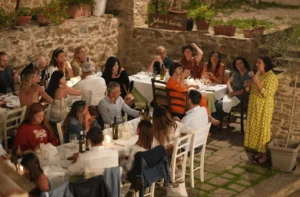
After the Design Challenge, we celebrate together!
The design of the play centre was not limited to imagining a space simply dedicated to play. It also became an opportunity to rediscover the identity values of the territory.
Ecology, conviviality, biodiversity, sociality and the Mediterranean Diet were all considered in order to achieve the best possible result. The children learned to reflect on these topics through a holistic perspective, fully respecting the principles on which the Pollica 2050 project was founded.
Toward the end of the activity, the working groups were reshuffled according to different thematic areas and based on the participants’ interests and preferences: from sport to digital technology, through ecology, creativity and sociality, each group contributed to creating a result capable of fully expressing local identity while also finding a balance among the many proposals put forward.
Future Food Institute President Sara Roversi also expressed her satisfaction with the outcome of the hackathon:
“We did not design a simple ‘play centre’, or a dreadful ‘baby parking’ facility, but a community home capable of expressing its identity, preserving the values of the territory, nurturing ecological awareness among younger generations, stimulating creativity and integrating digital technology in a ‘smart’ way so that it can truly become an effective tool for improving our lives rather than a source of alienation.”