Is there a way to produce healthy, nutritious food at a fair price, capable of adapting to and even mitigating climate change?
Can agriculture and the agrifood system, currently responsible for 24% of greenhouse gas emissions, capture climate-altering gases and restore carbon stocks in the soil?
Two crucial questions for addressing and solving the challenges of this century, which inevitably bring us back to the urgent need for awareness, sustainability, care and regeneration.
A regener-action that requires awareness and active participation and that cannot be lasting unless it is deeply rooted in local territories and their communities.
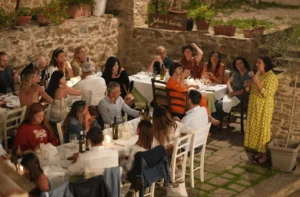
For this reason, at the end of January the Bologna Living Lab reopened with the monthly events of “Food is a Conversation” – special edition RegenerAction, a theme that will accompany us throughout 2022 to reconnect the community and reflect together on the challenges facing local and global food systems.
At its first inspiring event in Bologna, we welcomed several guardians of the Mediterranean:
Serena Cilento from Cooperativa Agricola Nuovo Cilento – “Al Frantoio” and Edmondo Soffritti from Azienda Agricola La Petrosa, two pioneers of regenerative agriculture applied in the heart of the Cilento and Vallo di Diano National Park and leading figures in the Rareche Mercato Rurale Naturale movement.
They shared valuable seeds of wisdom together with Francesco Mazzi, a young entrepreneur from Società Agricola Valbindola in the small town of Tredozio in Emilia-Romagna, and Cesare Zanasi, Associate Professor at the Department of Agricultural and Food Sciences and Technologies of the University of Bologna, who has been studying “Eco-Regions” and development models based on regenerative agricultural practices for years.
The event was moderated by our Alessio Corti, who directs the Paideia Campus from Pollica, and opened the door to inspiration by bringing concrete examples of success and helping us understand the needs, approaches and opportunities offered today by regenerative rural development models.
RegenerAction means restoring broken relationships starting from the land
“Today we are used to consuming with extreme ease rather than producing. We have lost our connection with real things and with what actually happens in nature. There is seasonality, there is a way of doing things. We need to return to normal things, starting from the land and the soil.” – Serena Cilento
Returning to forms of regenerative agriculture therefore means restoring these broken relationships with the land and the soil because, as Edmondo Soffritti masterfully explained, “practising regenerative agriculture means adopting all those practices aimed at preserving or increasing soil vitality”.
A vital soil is not only naturally capable of capturing carbon, but is also perfectly in harmony with the entire natural ecosystem, resistant to erosion and rich in organic matter.
Those who work the land therefore become guardians of these ecosystem processes and have the responsibility to promote minimal and shallow tillage in order to reduce the mineralisation of organic matter and soil erosion, ensure proper water management and protect its health, and use natural compounds to support the formation of humus and organic matter.
These are long and complex processes that go far beyond simply replacing conventional farming methods with organic methods. Instead, they restore the entire environmental and ecosystem complexity, delivering a unique value: the value of resilience and resistance.
While intensive monocultures may undoubtedly provide greater yields and economic profits, they are also among the main victims of invasive alien species and diseases, which, when aggressive and widespread, can threaten an entire economy.
These risks can instead be prevented at their source by those who, with care and attention, ensure constant ecosystem balance.
RegenerAction means creating the right soil for the community
Deeply understanding that working the land means having a direct relationship with life, which spreads and thrives even where it remains hidden, starting below the soil, brings with it an invaluable benefit: helping to restore lost relationships between human beings.
Since regenerative agriculture began taking root, farmers have worked with greater motivation, supported by a strong human value system that keeps them more united, more rooted and less alienated, as our guests explained.
Networks of collaboration and cooperation make companies and individuals feel part of a larger mission, such as the one created by Cooperativa Nuovo Cilento and its 400 members, or the more recent consortium developed by Francesco Mazzi, bringing together farmers and producers driven by care for the ecosystem, sharing experiences and skills, and exchanging advice and best practices.
It is a way of keeping communities and the villages they inhabit together, of cultivating the social fabric as well as the land, and of countering the risks of abandonment and depopulation, especially in small towns located in inland and mountain areas.
These bonds unite communities and strengthen relationships between employers and employees, as well as between producers and consumers.
“Today the relationship with the customer becomes more genuine because you are proud of the product. You can tell them what you are doing for its ecosystem and why you are doing it,” shared Edmondo Soffritti.
RegenerAction means creating, exchanging and communicating the value of the entire territory
The bonds and distinctive characteristics of a territory can be clearly identified in the dynamics between people and the products of the land, in relationships within the community, but also in the historical, social and cultural dimensions that uniquely define a specific place.
BioDistricts, which are gradually gaining ground internationally, across Europe and nationally, provide a perfect example of an expanded form of regener-action applied to an entire territory.
Starting from organic and regenerative agriculture, their core purpose is to bring together the commitment of farmers and trade associations, as well as universities, local municipalities and all stakeholders who have a direct or indirect relationship with the sustainable development of the territory.
“Because regenerative agriculture regenerates not only the soil, but also relationships within the community and its territory,” as Professor Cesare Zanasi emphasised. He has been studying the dynamics of BioDistricts since 2004 as innovative approaches to integrated and sustainable rural development.
These are processes in which social, environmental, economic and ethical dimensions are perfectly harmonised and become firmly established only when they are communicated through example, creating a critical mass capable of working through networks and implementing radical cultural change.
It is a process that inevitably takes time, like every natural process, and that is nourished by the complete sense of community we have forgotten, as Serena Cilento reiterated: “exchange is in our genetics, from the community bread that used to be shared in the street to our grandparents who had vegetable gardens outside their homes and, when they had too much lettuce, knocked on their neighbour’s door to share it”.
A paradigm shift is needed to raise awareness and properly communicate the underlying values, starting precisely from the emulation of small regenerative agricultural models, small farming systems often located in marginal areas but fully regenerative, like those found in many BioDistricts such as the Cilento BioDistrict, an area covering 3,196 square kilometres, 36 municipalities and 400 organic farms focused on multifunctionality.
This is the model of integral ecological regeneration that, from the Paideia Campus in Pollica, we are seeking to implement through the collective and multidisciplinary efforts of various local stakeholders.
An approach that, this very week, during the presentation of the ISMEA – Qualivita 2021 Report, was recognised as crucial for promoting the real competitiveness of our country by Oreste Gerini, Director General at the Ministry of Agricultural Policies, and by the Minister of Agricultural Policies himself, Stefano Patuanelli.
A model that starts from the sustainability and quality of small-scale production, at the heart of local territorial development.
A form of development that sees diversity, identity and regener-action as the true expression of Italian resilience.